Exhibition Review Wybielanie / ‘Bleaching’ at National Ethnographic Museum of Warsaw
Wybielanie (02.04.2025 – 30.04.2026 , Państwowe Muzeum Etnograficzne w Warszawie). Curators: Witek Orski; Magdalena Wróblewska
Wybielanie is a self-reflexive exhibition in Warsaw which ultimately looks at the National Ethnographic Museum’s own exhibitory history. It does so through the analogy of ‘bleaching’. The premise of the exhibition is to showcase objects that the meteorologist and ethnologist Leopold Janikowski [1855–1942] collected in Cameroon between 1882 and 1885 and sent back to Warsaw. His expedition to Africa was partially funded/supported by the aristocratic ‘epic’ writer Henryk Sienkiewicz [1885–1916]. The excursion was a collective effort with the geologist Klemens Tomczek [1860–84] who died during their voyage. The participation of the explorer and Russian naval officer Stefan Szolc-Rogoziński [1861–96] was perhaps more important, however, since he became the founder of NEM, largely relying on the objects brought back during this first African expedition.
This group’s foray into ‘the unknown’ is widely acknowledged as the first Polish expedition into the African continent. The main goal had been to found a colony in central Africa and so these explorers purchased land there. Shortly after, however, these acquisitions were commandeered by German colonisers. What is more, the expedition, unbeknown to itself, had created a narrative for the origins of Warsaw’s Ethnology Museum and the failure of its mission. It became a baptismal event of sorts, as an historical construction that was trying to fashion a past in which Central Eastern Europe could exempt itself from colonial critique. In this way, one can argue that the latter shares something with the former. Further, the framework justifying the objects now on display from the museum’s collections is that of de-mythologising Poland / Central Eastern Europe’s innocence from colonial exploitation. ‘Innocence’ is indeed a carefully chosen keyword used in Wybielanie’s online summary, given the country’s Catholic past. The exhibitory curation itself consciously plays with this history through a narrow range of religious motifs.
A Walk Through the Exhibition
The exhibition inhabits two small rooms, roughly fifty square meters in total, on the Museum of Ethnography’s second floor. The walls in the exhibition space have been painted off-white (Fig. 1). The floor is comprised of herringbone wooden tiles. From the perspective of the entrance to the exhibition, along the right-hand side of entrance, there is a series of texts that have been set in Times New Roman type face at around a viewer’s eye level. The absence of higher case letters at the beginning of the extracts suggests these might have been taken from a textbook. The text, in both Polish and English gives an overview of what is meant by Bleaching in this context. Together with the objects on display, the textual narratives on the walls tell a story of how some of the museum’s collections came into people’s hands and in some cases were lost again.
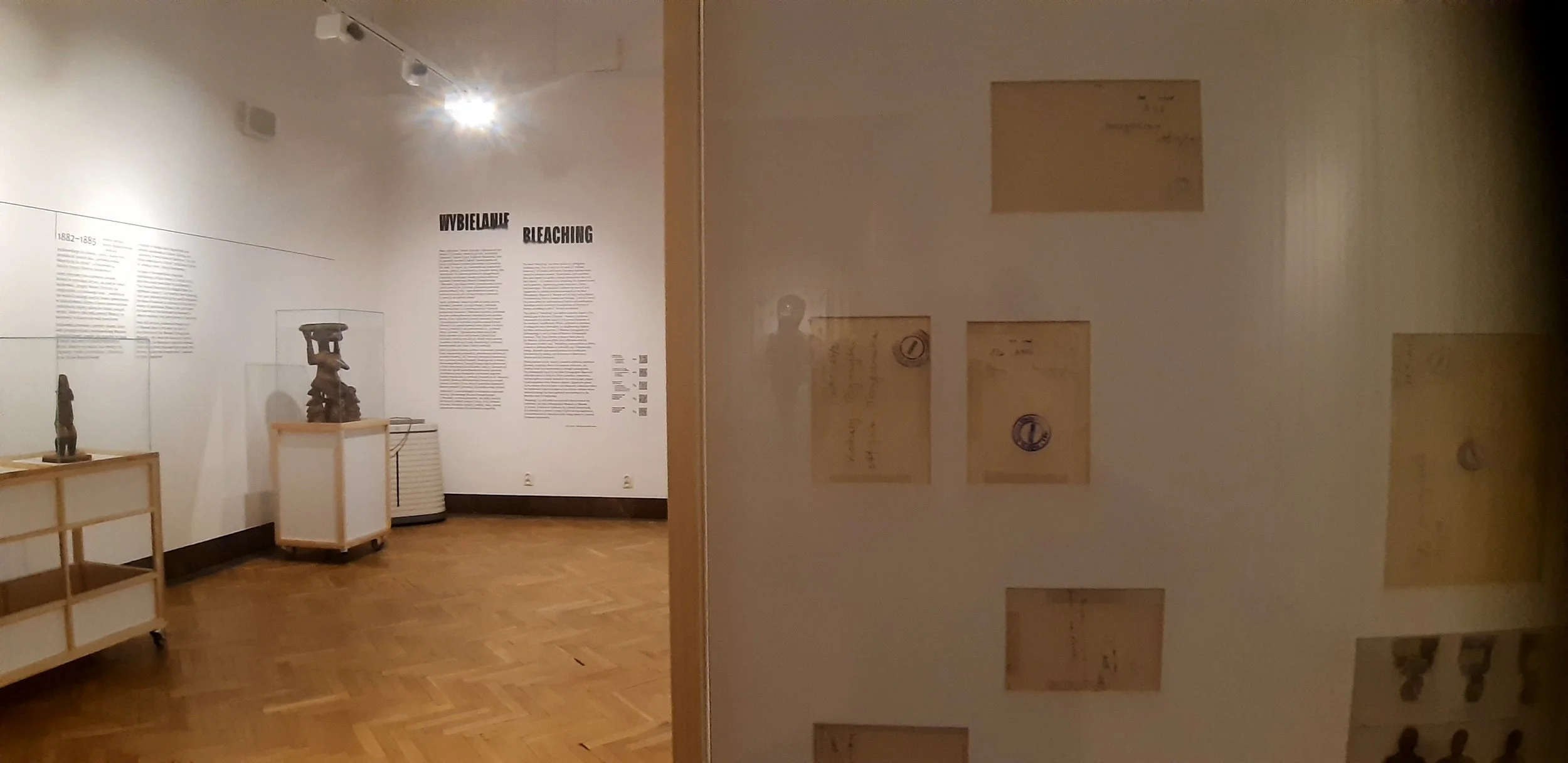
Fig .1: Bleached out stories: Looking towards the exhibition entrance © Patrick Laviolette
Accompanying this story of the museum’s origins in this abbreviated history of the museum, visitors can also see some ‘sacred’ and some ‘artisanal’ works of art. These are mounted on or embedded in movable, IKEA-esque wooden cases and spatial dividers. Immediately to the visitor’s left as they enter the hall are two wooden figures in a glass case. They are facing in the same direction as our gaze towards an empty central space.i These carvings are decorated in very similar fashion. They might be compared to marionette gatekeepers. The other figures in the exhibition are displayed along the right side of the room. There are only a few of them. The first one a visitor is likely to notice on the right-hand side of the room is a female figure. Hers is a fecund body. She appears to be being carried on the shoulders of four women below her. The label on the wall says it’s an example of a sculpture brought back from Cameroon by Rogoziński. Her body might remind some viewers of the Venus of Willendorf.ii Further along the exhibition there is another wood carving, likely of a woman, but more androgenous. This carving appears to be made from ebony. In comparison to the previous figure, this body has a number of other bodies (children) that appear to grow from it (Fig.2). It contrasts with the wooden figure of a woman supported by four other women because that representation of a fecund body is very much an individual body, whereas the ebony carving is multiple bodies in one (dividualistic in the jargon of anthropologists). Above the wood figures there is a series of texts. One of those texts tells us that in 1884 a man called Leopold Janikowski ‘brought back to Warsaw objects that were the start of the collection of the Warsaw Ethnographic Museum…’. It is these that eventually formed most of the main collection.
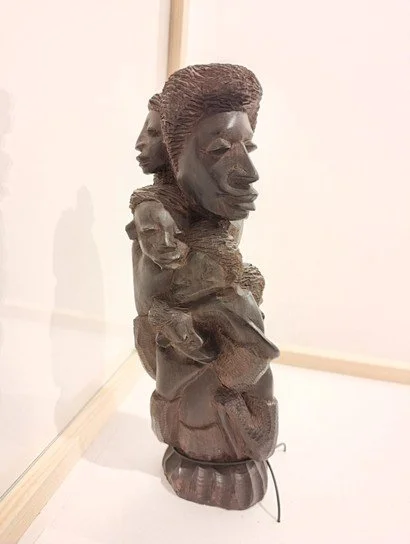
Fig.2: ‘Kinship’ carving, representing different generations and the communal/dividual body © Neil R. Thomas
Across from these small, encased sculptures, framed on the left-hand wall is a poem from 1919 by the Jamaican American poet Claude McKay [1889-1948] entitled ‘The Little Peoples’ (Fig 3). It lends a certain visual pathos to the small, austere A5 handouts that are available as one enters into the exhibition through the gallery doors. One of these leaflets showcases another poem called ‘Wolof’s Gift’ written by the Kenyan writer Thelma Njoroge (n.d.) printed in Polish and English. Wolof is the language spoken by nearly half of the population of Senegal, some 18 million people. The poem is deeply decolonial in referencing not only Portuguese ships, but also the many exiled hands of cooks in the kitchens across Poland’s capital.
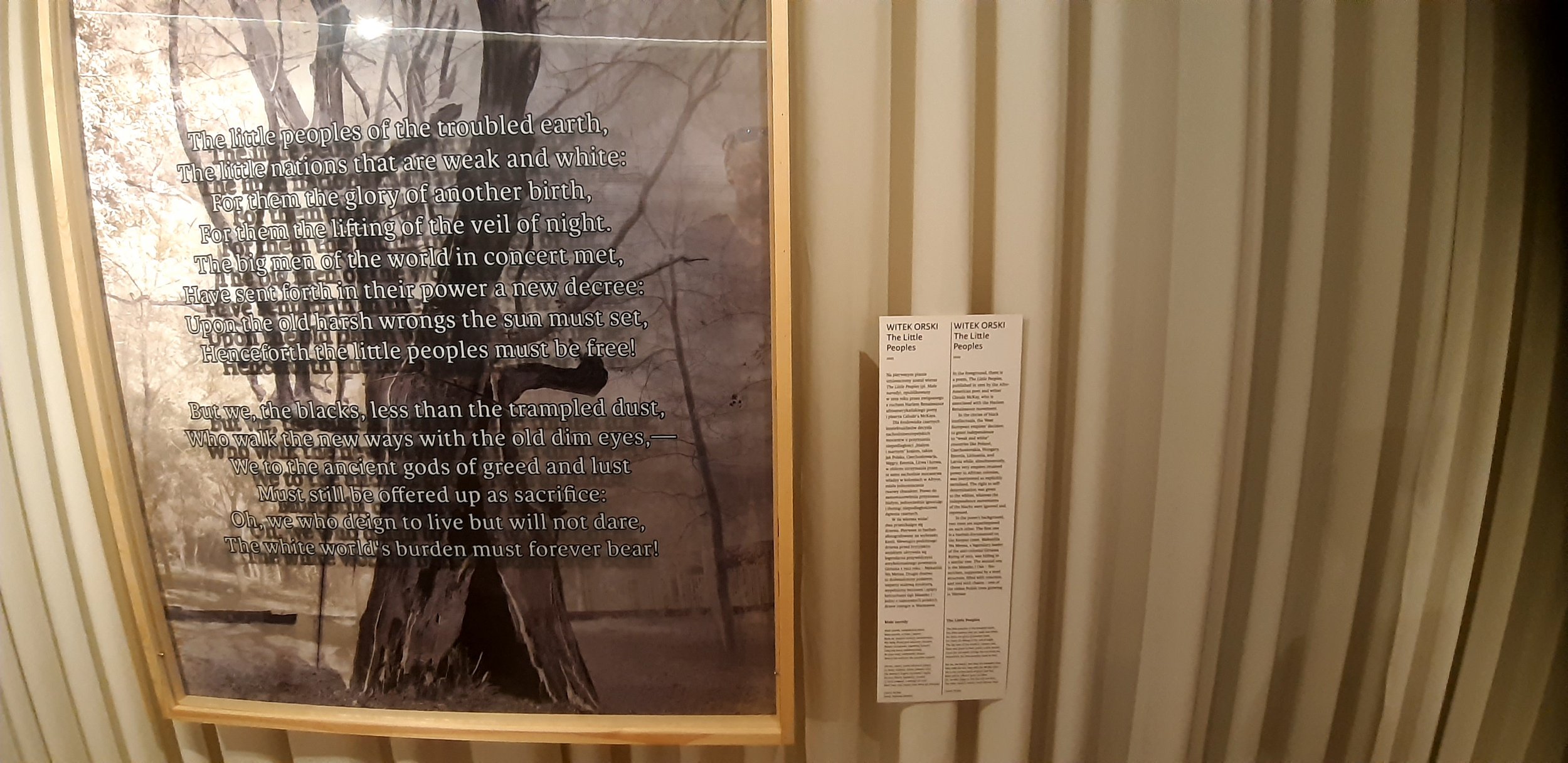
Fig. 3: ‘The Little Peoples’ (1919) poem by Claude McKay © Patrick Laviolette
Another A5 sheet handout (again printed in Polish on one side, English on the other) consists of a set of provocative questions. It is titled ‘Beyond the frame’ and asks visitors to think about what they see in the photos, and what they image lies outside. There is a commentary on how many photos and postcards are inscribed on the back with ‘scientific’ descriptions. These questions direct the exhibition viewer to look at the mounted photos, which give typologies of African hairstyles, and then compare these with the images in the picture book from 2000 below them compiled by Okhai Ojeikere [1930-2014], a Nigerian photographer. This little display is placed just after the McKay poem and acts as a threshold of sorts to the second gallery hall. Ojeikere’s book on African hairstyles chimes with more contemporary pop-culture facets of African culture (Fig. 4).
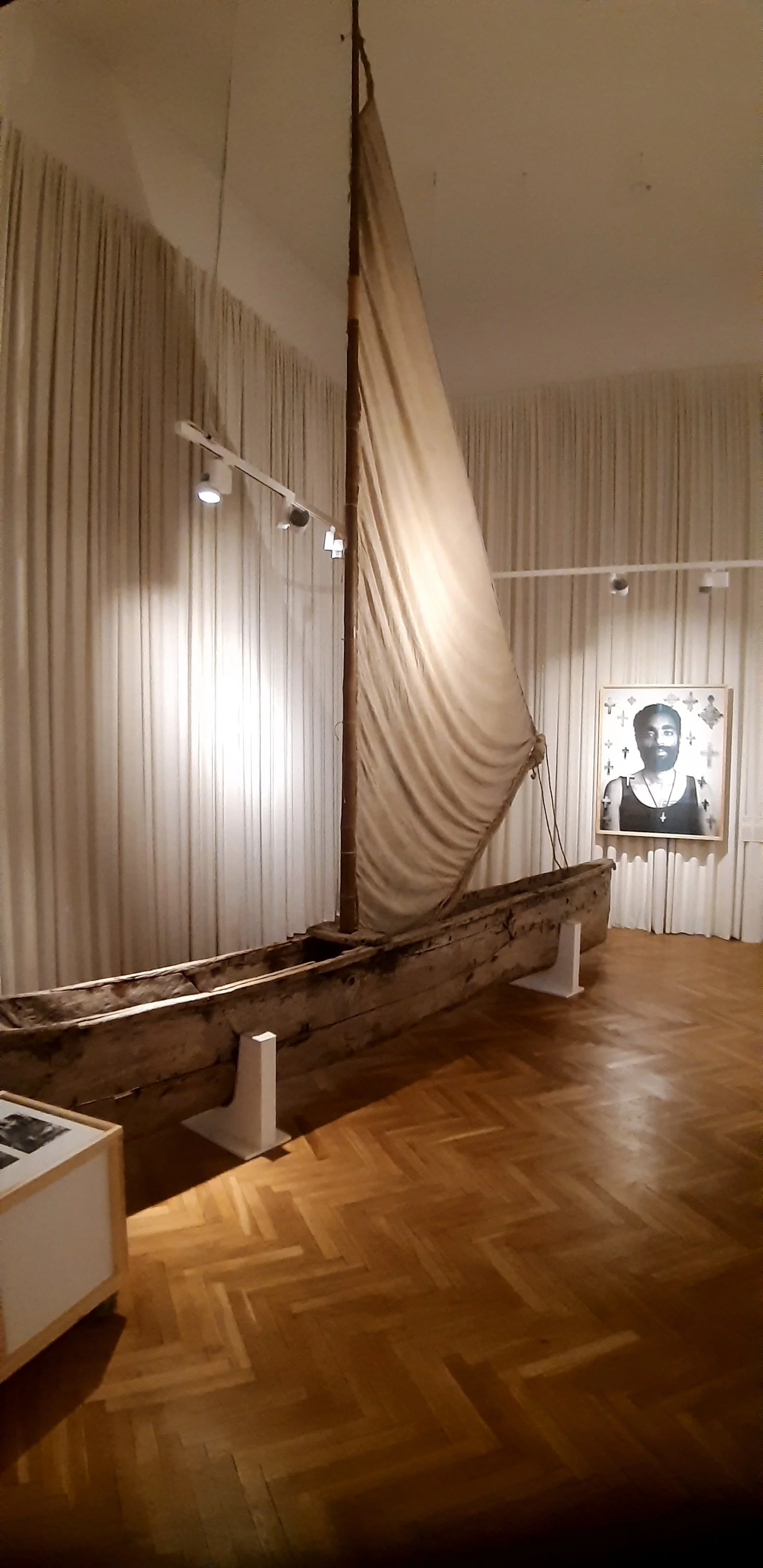
The artefacts on display along the right-hand side of the main room help to configure a story – a materialised story of Africa’s past that is supported by a narrative structure written on the walls. This left-hand ‘text heavy’, right-hand ‘object weighted’ distribution is inverted in the second room. This slightly different composition is noticeable in that the main textual element on the walls is not a poem, but a timeline of the museum’s history can be found on the right-hand side (Fig. 5). The back gallery space is slightly wider, but smaller and with fewer objects. After a partial division, not quite in the middle of the room, on the left, there’s a small sail wooden boat. In front of the boat there are some photos and descriptions of how it was purchased in 1966 by writer, medical doctor, traveller and collector of ethnographic objects Wacław Korabiewicz [1903-1994]. Given its location in the gallery setting, the boat acts as a vector of colonialism – in between rooms, as if they were separate continents, transporting people, things, beliefs, ideas and so on.
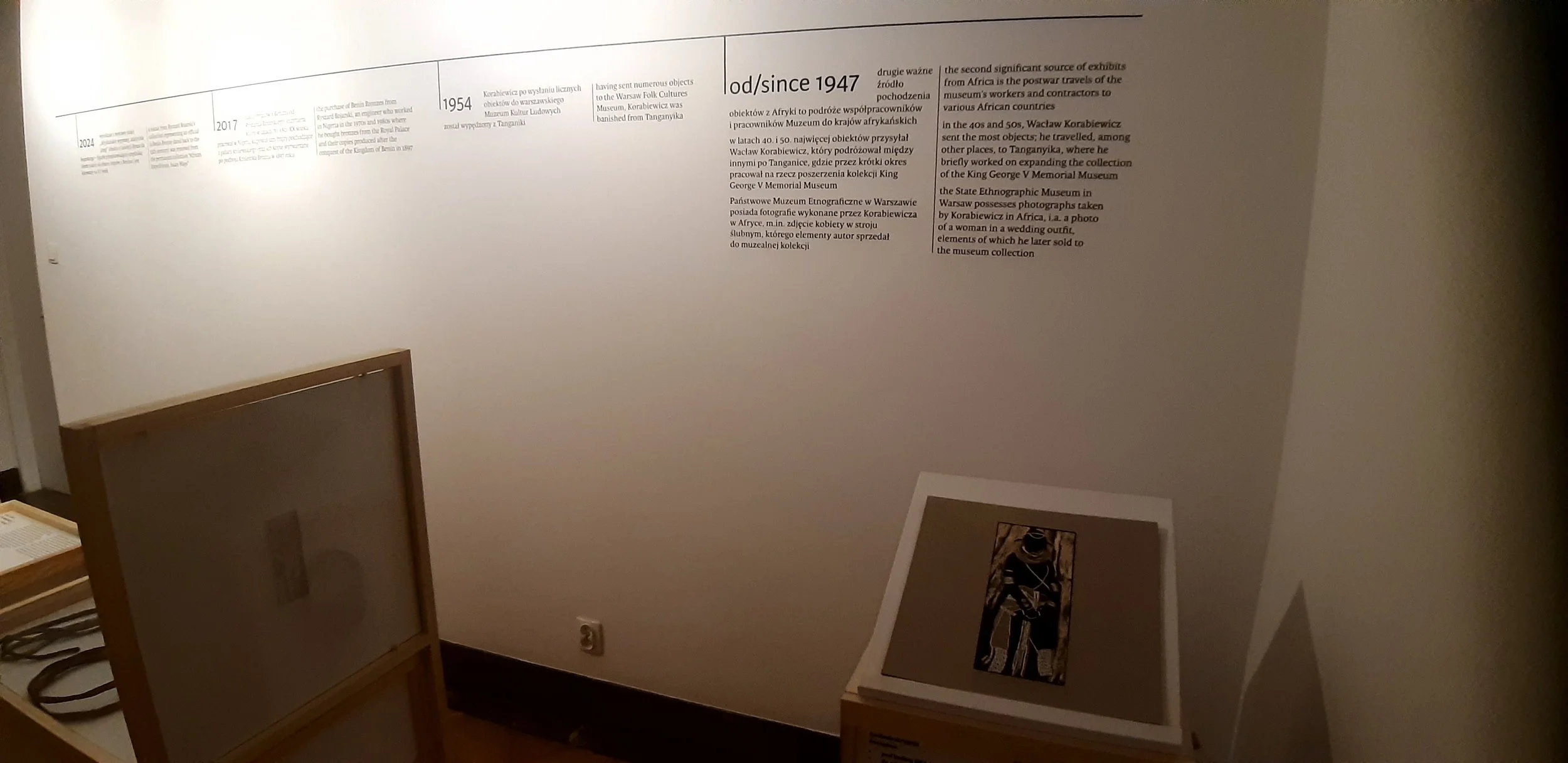
Fig. 5: Display cases, mounted photos and NEM’s timeline [1947-2024] © Patrick Laviolette
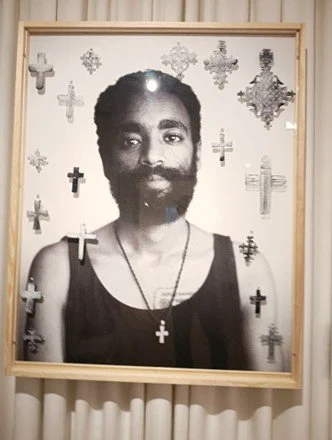
The boat’s off-centredness and adjacent angle to the walls points to a large, framed photograph in the middle of the back wall. It is a picture facing us as we walk in, of a bearded ‘person of colour’ wearing a black tank top and a crucifix, with several Catholic crosses superimposed onto the print. His gaze surveys the central part of this room and when seen with all this religious accoutrement, it is not difficult to draw the analogy that his vague, camp Freddy Mercury appearance is also meant to satirise the figure of a black-Jesus. This portrait is set against a back wall which is not painted, but rather (as with the wall to the left) covered in hanging curtains – the same off-white colour as the painted walls. The ripples in the fabric, along with the lighting above, provide what some viewers might contrive as little vertical water undulations which nestle the small fishing vessel (Fig. 6a/b).
All along the wall on the right, one can see a timeline of the museum’s history. On both sides at the entrance of the second room are some framed postcards and encased sculptures. In the back section of the exhibition, some postcard photographs are mounted on Perspex glass so that we can see the flip sides as well, which is less the case with the photo images in the first room. Here an odd inaccuracy in the exhibition stands out – a photograph of a young woman sitting for a photographic portrait bears the slippage since the it has been ‘masked’ for display. The exhibition curators have placed a black bar of plastic or tape across the torso of the sitting woman, obscuring her naked breasts. It is difficult to determine the intention. If it were to spare the viewer any sense of indecency, it would need to have also been applied to the photograph of a bride in a setup of images closer to the boat. In the censored photo, the woman looks neither timid nor afraid. On the contrary. If there is any discomfort, it’s at the cover-up. The latter is a self-imposed kind of contemporary statement. Were it self-reflexive, perhaps a white strip of concealment would have been more congruent with the bleaching performativity of the exhibition as a whole. The cover-up thus seems to posit an attempt to assuage embarrassment or, perhaps, envy at such detached
bemusement. While the photograph cannot escape its staginess, it is no fraud. That is, it depicts a genuine sense of visual reciprocity, whereby we’d risk asking: why not go all the way with Frantz Fanon’s idea that it is when allowing for candor and misrepresentation that one is most likely to embrace truth, rather than when engaging in acts of concealment? In his words: “Today I believe in the possibility of love; that is why I endeavor to trace its imperfections, its perversions” (1967: 42).iii
Hence, the notion of ‘bleaching’ – which we feel arises as a response to a dialectic conversation between the exhibition (including its curators) and the public – is, in Fanon’s sense, less a neatly governed process than a messy dance between visual objects and bilingually written text. The oscillation of objects in that dance accounts perhaps for how they begin to lose some of their colour as their meanings travel from the left hand to the right, from a poetic logic to an objectified affect. As visitors navigate through the artefacts in both rooms, they move through ancient and more recent historical contentions. This setup is fascinating, especially in examining the handwriting, the stamps and other small details, which allow the viewer to understand how such visual representations are authenticated and rendered official/scientific. Historians of visual media will be reminded of looking at archives of printed photographs. This is a delicate and subtle touch of curatorial reflexivity. It reveals an access point to the material that is normally concealed from the public, sometimes even when granted permission to view such sources first-hand in an archive.
Now, it is perhaps no coincidence that this exhibition finds expression 100 years after Fanon's birth. Could it not be suggested that Wybielanie is some type of inverted response to the thoughts expressed in Fanon's (1967) book Black Skin, White Masks, whereby he argued that blackness has been consistently concealed historically behind processes of white colonial settlement, domination and appropriation? In these terms, Wybielanie acts as an ‘off-white’ canvas upon which ‘black objects’ are foregrounded and/or imprinted (Baker et al. 2023). Seeing it as a canvas of this type, from whichever stance viewers take, it is not possible to remain innocent to the impressions they leave on the acquisition and expropriation of materials. We are therefore clearly dealing with how anthropology and ethnology in Warsaw (and Poland more generally) wish to position themselves in terms of discourses dealing with what Raymond Patton (2024) has called Imperial Exceptionalism, or what Filip Herza (2020) has labelled ‘colonial exceptionalism’ in relation to central eastern Europe more generally. Or even with what social theorists have referred to as the global ‘non-alignment movement’, established as the result of the Indonesian Bandung Conference in 1955 and an ensuing summit in the former Yugoslavia in 1961.
REFERENCES
Baker, Catherine, Bogdan C. Iacob, Anikó Imre & James Mark (eds), (2024), Off White: Central and Eastern Europe and the Global History of Race. Manchester: University Press.
Fanon, Frantz (1967), Black Skin, White Masks. London: Pluto Press.
Herza, Filip (2020), Colonial Exceptionalism: Post-colonial Scholarship and Race in Czech and Slovak Historiography. Slovenský Národopis, 68(2): 175–187.
Ojeikere, J.D. ’Okhai (2000). Photographs (Hair Styles). Zürich: Fondation Cartier pour l’art.
Patton, Raymond (2024). In-Between Empire: Imperial Exceptionalism, Poland, and Colonial Travel Writing. London: Bloomsbury.
Endnotes
1) An interesting thought experiment from the perspective of non-humans subjects would be to imagine the exhibition as if experienced from the point of view of the sculptures – as we walk past them, they become more than just observed objects, but observers in their own right.
2) This is the encased carving on the left-hand side of Fig.1 https://simple.wikipedia.org/wiki/Venus_of_Willendorf
3) Original published as: Fanon, F. (1952), Peau noire, masques blancs. Paris: Éditions du Seuil.